Short answer: Every chimney, every year. NFPA 211 calls for an annual inspection of every chimney, fireplace, and vent regardless of how much it was used, and that standard applies to a 300-unit association exactly the way it applies to a single-family home.
For one homeowner, that is easy advice to follow. For an association with 200 fireplaces spread across 60 buildings, the standard is not the hard part. Access is. Scheduling around residents is. So is ending up with one consistent set of records instead of a folder of receipts from whichever contractor each owner happened to call.
Why annual, even for the fireplaces nobody uses
Two reasons boards tend to underrate.
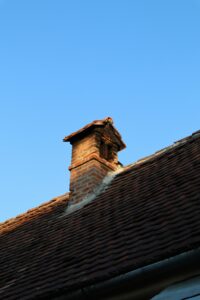
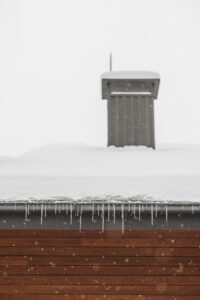
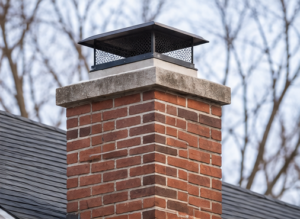
First, deterioration is not driven by use. Chase covers rust. Mortar spalls. Crowns crack and flashing fails, on the same schedule whether the firebox saw forty fires last winter or none. In Minnesota, the freeze-thaw cycle does more damage to a chimney than burning wood in it ever will.
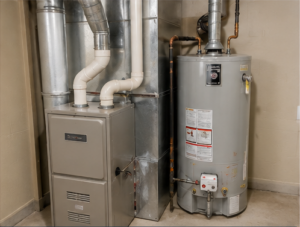
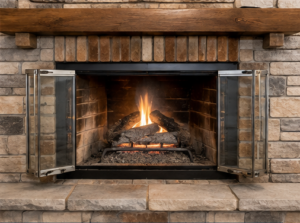
Second, “nobody uses it” is an assumption, not a fact. Units turn over. A new resident finds the fireplace, buys a rack of firewood, and lights a system that has not been looked at in nine years. Gas appliances are the quieter version of the same problem: they vent, venting can fail, and almost nobody thinks about them.
What Level 1, 2, and 3 inspections actually cover
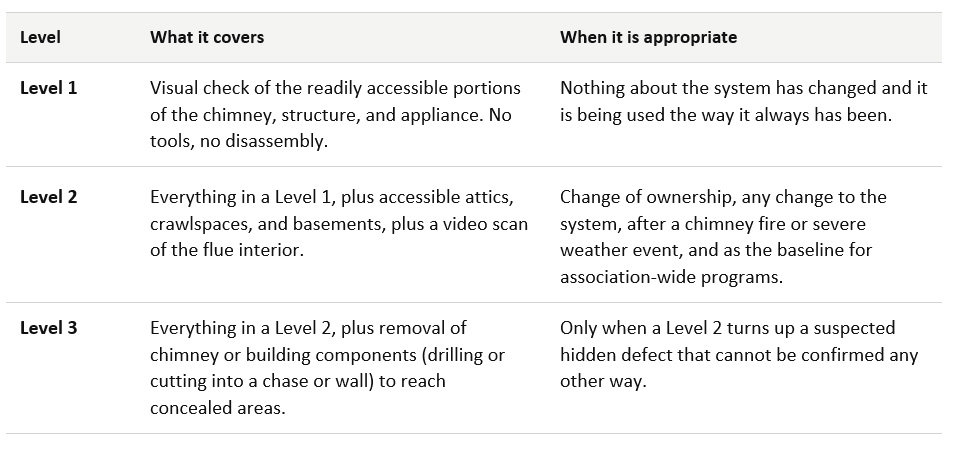
Not all chimney inspections are the same. The difference matters for your budget and for understanding what you are actually buying.
Why we recommend Level 2 as the association standard
A Level 1 tells you what is visible without effort. That is reasonable for a homeowner who has had the same system inspected every year and changed nothing. It is thin for an association taking on responsibility for chimneys it has never had eyes on.
The difference is the video scan, and the video scan is where liner problems live. A cracked or separated clay liner does not show from the roof or from the firebox. Neither does a deteriorated metal liner inside a prefab chase. On a property-wide baseline, that is the difference between a report that says everything looks fine and a report that tells you what you actually own.
Level 3 is a different animal and it is not routine. It is invasive by definition, it costs accordingly, and we do not call for one unless a Level 2 found something specific that cannot be assessed without opening up the structure. Any contractor recommending Level 3 work across a property without that finding is worth a second opinion.
Insurance, fire code, and the paper trail
This is where a maintenance line item turns into a risk-management line item.
NFPA 211 is the standard that insurers and fire officials generally reference for chimney and venting systems. After a fire, the questions come fast: when was this last inspected, by whom, what did they find, and what did the association do about it. A documented annual program answers all four in about a minute. Ad hoc records collected from individual owners before the association took the program over usually answer none of them.
That gap shows up at the worst possible moment, in a claim, a subrogation fight, or a homeowner asking the board why nobody knew.
What a property-wide program looks like
One contract instead of two hundred. One inspection standard applied the same way to every unit. One set of records in the board’s files, formatted identically across the whole property.
We run these programs across entire associations, including projects in the hundreds of townhome units and fireplaces, which means the coordination work is ours rather than the manager’s: resident notice, scheduling blocks, access, and chasing down the units nobody was home for.
Where to start
Most boards start with a baseline Level 2 across the property. That gives you a condition report, a prioritized repair list, and a real number to build into the reserve study. After the baseline, the annual cycle is routine.
Call Chimney Doctors and we will scope your property.
Frequently asked questions
How often should an HOA inspect its chimneys?
Annually. NFPA 211 calls for an inspection of every chimney, fireplace, and vent once a year, regardless of how much it was used during that year. The standard applies to gas appliances as well as wood-burning fireplaces, and it does not change because the units belong to an association.
Do chimneys that are never used still need to be inspected?
Yes. Most chimney deterioration is weather-driven rather than use-driven: chase covers rust, crowns crack, mortar spalls, and flashing fails whether or not anyone lights a fire. Unused systems also tend to be the ones a new resident fires up without warning.
What is the difference between a Level 1 and a Level 2 chimney inspection?
A Level 1 is a visual check of the readily accessible portions of the chimney and appliance, with no tools and no disassembly. A Level 2 adds accessible attics, crawlspaces, and basements, plus a video scan of the flue interior, which is the only way to see liner cracks and separations.
When is a Level 3 chimney inspection required?
Only when a Level 2 identifies a suspected problem in a concealed area that cannot be evaluated any other way. A Level 3 involves removing chimney or building components, such as drilling or cutting into a chase or wall, so it is the exception rather than the routine.
Does an association need to inspect gas fireplaces too?
Yes. Gas appliances vent, and venting systems fail. They are inspected on the same annual cycle as wood-burning systems, and they are frequently the ones with the least documentation because residents rarely think about them.
Can skipping chimney inspections affect an insurance claim?
It can. Insurers and fire officials generally reference NFPA 211, and a documented annual inspection program is the record that shows an association maintained its shared systems. Gaps in that record can complicate a claim after a fire. Your association’s insurance agent can confirm what your specific policy requires.