Short answer: In most Minnesota townhome and condo associations, the chimney is a shared structure, which makes repairs the association’s responsibility rather than the individual homeowner’s. Your declaration is what actually settles it. Read that before anyone writes a check.
A homeowner calls in October. Smoke is rolling back into the living room, an inspector finds a cracked crown and a chase cover that rusted through two winters ago, and there’s a bid on the table. Now the board has a second problem: whose bid is it?
Why the chimney usually belongs to the association
Walk almost any Minnesota townhome community built in the 1980s or 90s and you see the same construction. One chimney chase serves two or four units. The masonry ties into the same wall assembly as the siding. The chase is framed as part of the building, not bolted on afterward.
There is no clean line where one owner’s property stops and the building’s structure begins. That is precisely why most declarations don’t try to draw one, and why associations generally treat the chimney the way they treat the roof: a common element, maintained out of the association’s budget.
Plenty of townhome associations go further and assign all exterior maintenance to the association regardless of what is technically shared. It is the only practical way to keep forty buildings looking like they belong to the same community. If your documents already cover roofs, siding, and exterior paint, the chimney is very likely in that same bucket.
What MCIOA settles, and what it doesn’t
Most Minnesota condominium associations, and many townhome associations, operate under the Minnesota Common Interest Ownership Act (Minn. Stat. ch. 515B). MCIOA sets the framework. It defines common elements and limited common elements, and it establishes that the association maintains the common elements.
What it does not do is tell you which category your chimney falls into. That is the declaration’s job, and declarations vary more than boards expect.
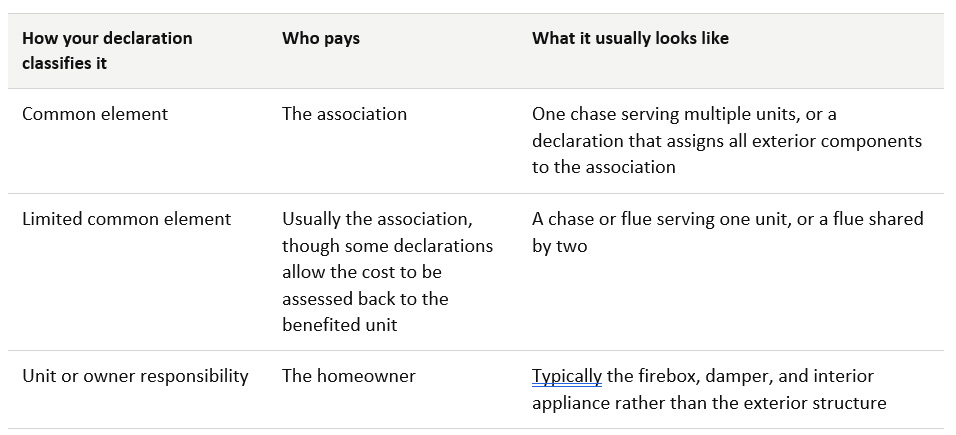
All three show up in Minnesota communities. Boards are often surprised by which one applies to theirs, mostly because nobody has had a reason to look since the documents were drafted.
How to answer the question without guessing
Three steps, roughly in order.
- Pull the declaration and find the maintenance section. Look for how it handles common elements, limited common elements, and exterior components. If the chimney is not named specifically, look at how roofs and siding are handled. That is usually your answer by analogy.
- Get an inspection before you assign the cost. You cannot tell from a photo or a homeowner’s description whether the problem is in a shared chase, a shared flue, or one unit’s firebox. The diagnosis frequently decides the category.
- Ask your association attorney about anything ambiguous, especially if the repair is large enough to require a special assessment.
One chimney is almost never just one chimney
Here is the part boards tend to miss. Forty units built the same year, by the same builder, with the same materials, have been through the same forty Minnesota winters. Freeze-thaw does not pick favorites. When one chase cover rusts through, the other thirty-nine are on roughly the same clock.
Handling that one complaint at a time is the expensive version. You pay for forty separate mobilizations, you get forty different scopes of work from whichever contractor each owner happened to call, and you end up with no consistent record of what was done or when. Assessing the whole property at once costs less per unit, and it gives the board something to budget against instead of a surprise every October.
That property-wide work is most of what we do. We work with property managers across entire associations, not one chimney at a time.
Not sure where your community lands?
We will walk the property, tell you what is shared and what is not, and hand you a scope you can take to the board. Call Chimney Doctors and we will get it on the schedule.
This post is general information, not legal advice. For a definitive answer on your association’s obligations, consult your governing documents and your association’s attorney.
Frequently asked questions
Does the HOA pay for chimney repairs?
In most Minnesota townhome and condo associations, yes. Chimneys and chimney chases are typically classified as common elements or limited common elements in the association’s declaration, which puts maintenance and repair on the association’s budget. The declaration controls, so confirm it there before assuming.
Is a chimney a common element or a limited common element?
It depends on the declaration. A chase serving multiple units is usually a common element. A chase or flue serving a single unit is more often a limited common element. Many townhome declarations skip the distinction and assign all exterior components to the association outright.
Does MCIOA say who pays for chimney repair?
No. The Minnesota Common Interest Ownership Act (Minn. Stat. ch. 515B) defines the categories and establishes that the association maintains common elements, but each association’s own declaration decides which category the chimney falls into.
Who is responsible for the fireplace inside the unit?
The interior appliance, firebox, and damper are more commonly the homeowner’s responsibility, even when the chimney structure itself is a common element. The declaration is still what settles it.
Can an association charge a chimney repair back to one homeowner?
Sometimes. When the component is a limited common element, many declarations allow the cost to be assessed to the benefited unit or units. Declarations also commonly allow chargebacks when damage results from an owner’s negligence or misuse.
How do we find out what our declaration says about chimneys?
Pull the recorded declaration and the bylaws and find the section on maintenance, repair, and replacement. Search for “chimney,” “common element,” and “limited common element.” If the chimney is not named, look at how roofs and siding are assigned; that is usually the answer.